

Everyone wants to innovate. Few want to question what innovation actually asks of you.
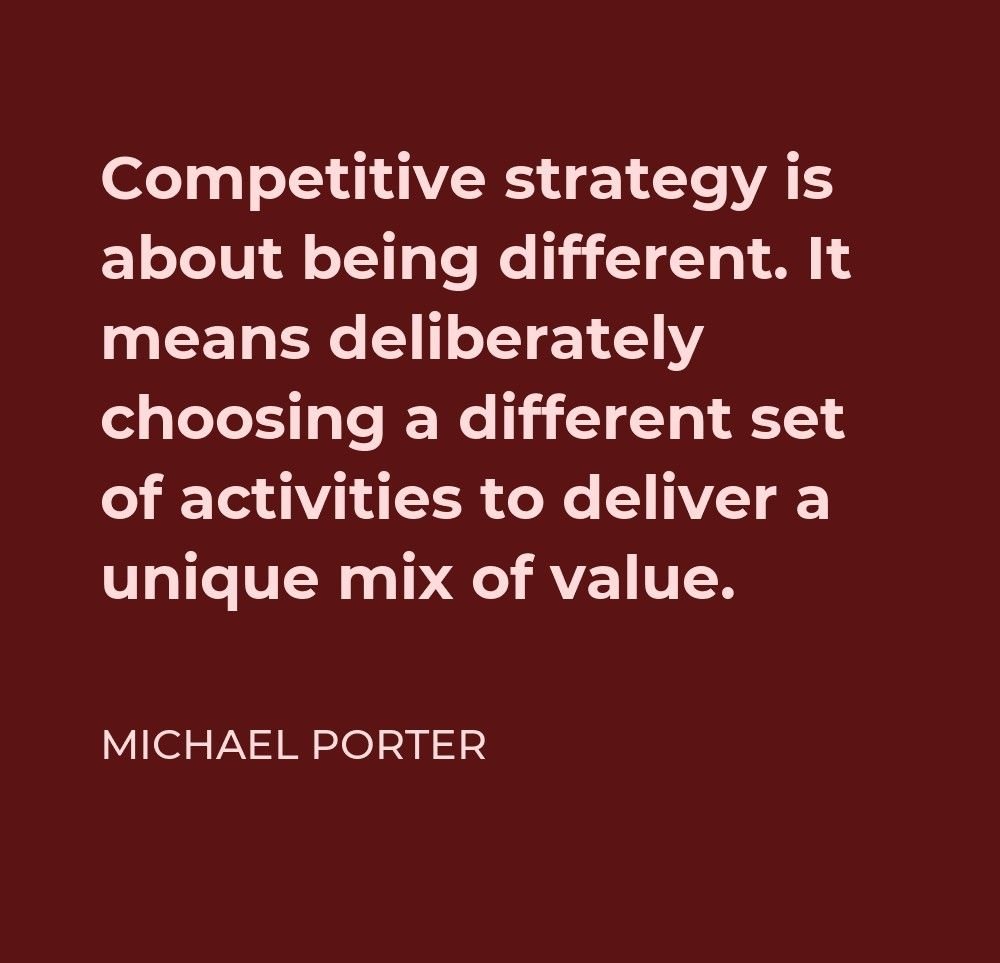
A line from the attachment stuck with me: doing the same things better isn’t strategy. It never was. Efficiency is improvement, yes. But strategy begins when improvement stops being enough. When you stop optimizing the obvious and start designing the alternative. When you choose a set of activities that creates a unique value only you can deliver.
In a world overflowing with copy-paste frameworks, cloned business models, and brands that feel eerily similar, what sets you apart isn’t just what you build, but how you choose to build it. Differentiation is no longer a feature, it’s the foundation. The real advantage lies not in being louder, but in being impossible to replicate.
And this is where Michael Porter’s perspective hits hardest: competitive strategy is about deliberately choosing a different set of activities to deliver a unique mix of value. Not copying a competitor’s playbook. Not doing last year’s strategy again with nicer slides. But designing an activity system that is so uniquely aligned, it becomes a fingerprint.
The irony? Most people don’t lose because they fail to improve. They lose because they never dared to be different.
The best strategy conversations aren’t glamorous. They happen when you ask uncomfortable questions like, Why are we doing this the same way? Who else is already doing this? What would happen if we stopped copying and started choosing? That’s where competitive advantage starts breathing. Not in boardrooms, but in decisions that reject sameness even when sameness feels safe.
So here’s my takeaway for anyone building anything today: Don’t ask how to beat the competition. Ask how to make the competition irrelevant. Not by dismissing them, but by building a combination of value that only exists in your execution.
Because strategy isn’t a trophy.
It’s the courage to redraw the map!
